In EMA and BlueCat’s new report, learn about the five-stage Network Observability Maturity Model and how your enterprise can move along it.
Network observability has become mission-critical for modern enterprises. As organizations accelerate cloud adoption, roll out software-defined SD-WAN and SASE, and integrate AI-driven applications, networks must deliver agility, visibility, and resilience at scale.
But according to new research from Enterprise Management Associates (EMA), many organizations are struggling to keep up.
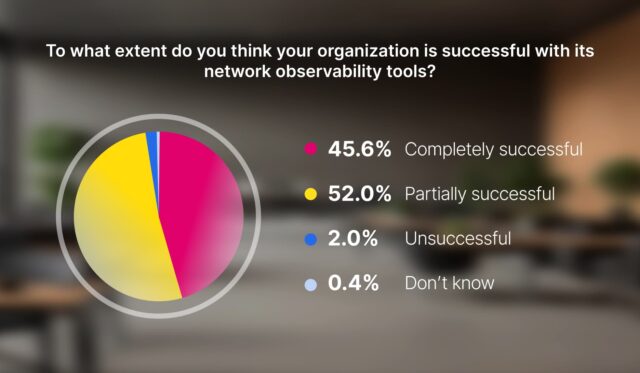
EMA’s 2025 report, The Network Observability Maturity Model: How to Plan for NetOps Excellence, reveals a surprising truth: Even though nearly every IT organization invests in observability tools, only 46% say they’re fully successful with them. The rest are stuck somewhere in the middle of the maturity curve.
The consequences are real: operational inefficiency, alert fatigue, tool sprawl, and an inability to meet the business’s growing expectations for uptime and adaptability.
In this post, we’ll first examine EMA’s five-stage Network Observability Maturity Model and where most enterprises land along it. Next, we’ll delve into why observability maturity matters and what separates leaders from laggards. Then, we’ll offer recommendations for how enterprises can climb the network observability maturity curve. And finally, we’ll explore how network observability provides a crucial foundation for true network modernization.

Stuck in the middle: What it means for NetOps teams
EMA’s five-stage Network Observability Maturity Model—developed in collaboration with BlueCat—defines a clear path from basic monitoring to AI-driven operations.
But most enterprises fall into the middle two stages: “Fragmented and Opportunistic” or “Integrated and Centrally Managed.” That’s where the majority of NetOps teams exist today.
In the Fragmented and Opportunistic stage, tools are siloed. Teams rely on a mix of vendor dashboards, flow monitoring, and ad hoc packet captures. They can see parts of the network, but not the whole picture. Each issue becomes a fire drill because tool correlations are manual and inconsistent.
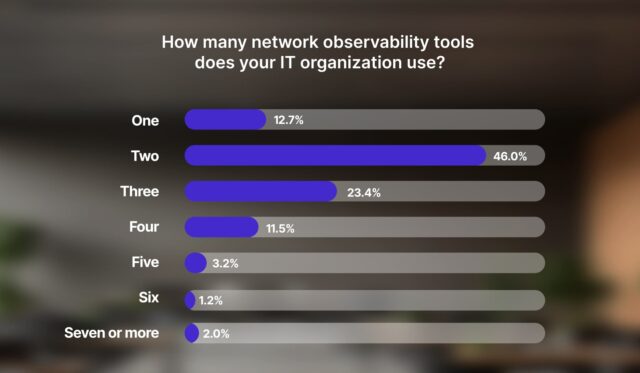
EMA found that 87% of enterprises use multiple network observability tools, often adding new ones to address visibility gaps. The result is tool sprawl and more complexity, not more clarity.
Organizations that progress slightly further reach the Integrated and Centrally Managed stage. Here, tools and data are unified under central control. Network performance is measured proactively, and operations teams monitor against defined service-level agreements. But automation and analytics are still limited, leaving teams reactive rather than predictive. IT managers can, understandably, get frustrated.
These middle stages represent progress but also plateaus. Without automation, AI-driven insights, or cross-domain integration, NetOps teams struggle to reach the next level of maturity.
Why network observability maturity matters now
The difference between mid-level maturity and best-in-class performance isn’t incremental; it’s transformational. EMA’s research shows that as organizations advance along the model, they achieve measurable improvements across four critical dimensions:
- Agility: Incident resolution accelerates as observability data becomes actionable.
- Efficiency: Deep integration reduces manual correlation and tool switching, freeing engineers to focus on higher-value work.
- Security: Observability data feeds directly into security information and event management (SIEM) tools, enabling proactive threat detection.
- Resilience: Automation and predictive analytics prevent outages and enable continuous optimization.
In other words, mature observability isn’t about monitoring more; it’s about understanding faster, acting sooner, and operating smarter. The result is true network modernization: Turning the network from a utility into a business catalyst that delivers flexibility, security, and speed.
What separates leaders from laggards
EMA’s study identified clear patterns that distinguish mature organizations from those stuck in the middle. Here are four areas where successful teams are pulling ahead:
- Reducing tool sprawl through integration. Nearly 90 percent of NetOps teams use three or more observability tools. But leading organizations focus on deep integration—not just sharing data—and coordinating it across data collection, alerting, and reporting. The best-performing teams automate workflows across tools, creating unified visibility and eliminating redundant systems.
- Expanding data coverage and depth. Successful NetOps teams ensure comprehensive data collection. They combine device telemetry (SNMP, traps, streaming data) with continuous packet monitoring to build real-time visibility. Many are extending observability into software-defined and cloud networks, capturing telemetry through APIs and flow logs. The goal is simple: eliminate blind spots. EMA found that teams with complete visibility across network infrastructure and traffic are three times more likely to report complete success with their observability tools.
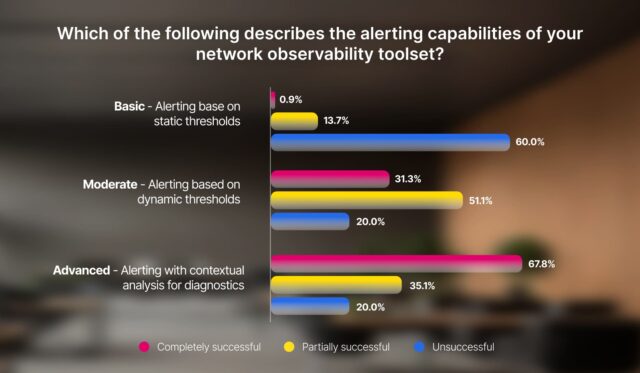
- Improving alert precision and context. Alert noise remains one of the most significant barriers to operational efficiency. In fact, only 29% of alerts are actionable according to EMA’s research. Mature organizations deploy intelligent alerting, using dynamic thresholds and contextual correlation to eliminate false positives. Alerts are enriched with diagnostic data, enabling engineers to act quickly rather than sifting through noise.
- Enabling AI-driven automation. The most mature teams are using AI and analytics to predict and prevent problems. They apply machine learning to correlate network events, identify anomalies, and even trigger automated remediation. EMA found that organizations with AI-assisted troubleshooting and automation achieve faster mean time to resolution and lower operational overhead.
How to climb the maturity curve
Reaching the higher stages of observability maturity, “Intelligent and Automated” or “Optimized and AI-Driven” requires both cultural and technical evolution. EMA and BlueCat outline five strategic moves to help organizations advance:
- Integrate tools across domains. Break down silos between network, cloud, and security teams to share observability data and coordinate responses.
- Automate data collection. Implement real-time telemetry and configuration change detection to ensure continuous visibility.
- Customize and integrate dashboards and reports. Deliver a single pane of glass across all observability tools to reduce swivel-chair operations. Customization and integration are key to assembling stories that are& meaningful to specific users, roles, and business units.
- Adopt contextual alerting. Replace static thresholds with intelligent analytics that map alerts to business impact.
- Leverage AI for prediction and optimization. Use machine learning to forecast network behavior, capacity needs, and potential failures before they occur.
Each step moves NetOps teams from reactive monitoring to proactive assurance—and ultimately to predictive, self-optimizing networks.
“I want to use different visualizations. I want more flexibility in visualization engines. As a system architect, I can’t predict everything that users will need. So, tools need customization features that will personalize user experience.”
–Monitoring tool architect, Fortune 500 media company
Observability as a foundation for network modernization
At BlueCat, we see observability maturity as more than an operational goal; it’s a critical step toward network modernization.
Our customers often start their journey in the same place that EMA describes: multiple point tools, inconsistent data, and manual troubleshooting. But by unifying visibility through BlueCat’s management solutions for DNS, DHCP, and IP address management (together known as DDI), and adding on LiveNX and LiveWire automation, security, and cloud observability tools, you can build the foundation for intelligent operations.
BlueCat’s approach empowers NetOps teams to:
- Consolidate tools and eliminate silos: Unified DDI data provides the single source of truth for observability.
- Automate core workflows: Self-service provisioning, automated remediation, and intelligent alerting reduce mean time to resolution.
- Enhance network resilience: Predictive insights and centralized management reduce downtime and support continuous improvement.
- Collaborate across teams: Shared visibility between NetOps, SecOps, and cloud operations drives faster, more coordinated decision-making.
These are the same capabilities that EMA identifies as the hallmarks of top-performing, AI-ready organizations.
Where does your organization stand with network observability?
Most enterprises are stuck in the middle of the network observability maturity curve, with more than half reporting only partial success with their network observability tools.
But if you’re among those stuck, you don’t have to stay there.
EMA’s Network Observability Maturity Model offers a practical roadmap for moving forward. Whether your organization is consolidating fragmented tools or exploring AI-driven automation, this model shows precisely how to advance along the path. By maturing observability, NetOps teams can shift from firefighting to foresight—transforming their networks into intelligent, adaptable, and resilient systems that drive business success.
Download the full EMA Network Observability Maturity Model report today to benchmark your organization and chart your next steps to reach AI-driven observability.